Times tables online: learning and revising them, from CE1 to CM2
Times tables are the basis of almost all calculation in primary and middle school: division, fractions, proportionality, areas. In the French system, they are built up in CE1 and CE2 (grades 2 and 3), then maintained up to CM2 (grade 5) and beyond. Here is the order in which to learn them, which tips make them easier, and how Galac6 (galac6.io) helps your child revise them online, in writing or aloud.
In what order should times tables be learned?
Children start with the simplest tables in CE1, finish all the tables up to 9 in CE2, then use them in both directions in CM1 and CM2 (grades 4 and 5). The French mathematics curriculum for cycle 2 lists the tables among the number facts to memorise, with daily mental maths practice.
- CE1: the first tables, those of 2, 5 and 10, then those of 3 and 4. The 2 times table relies on doubles, the 5 times table on half of the 10 times table.
- CE2: all the tables up to 9, to be memorised gradually, and multiplying by 10 and by 100.
- CM1 and CM2: the tables used in both directions (“7 × ? = 56”, “how many times does 7 go into 56?”), which prepare for division.
- In middle school, they are no longer a separate lesson, but they are used everywhere: simplifying a fraction, recognising a multiple, calculating with decimals.
In Galac6, multiplication follows this calendar: it arrives in mental maths series in January in CE1, and from the start of the school year in CE2 and CM1. In CM2, the tables come back in the share of revision from the previous year.
How can times tables be remembered more easily?
By reducing what really has to be learned by heart, then relying on a few tips. A table that seems long becomes much lighter once you see what you already know.
- Order does not matter. 7 × 8 and 8 × 7 give the same result. The 64 results of the tables from 2 to 9 therefore come down to 36.
- The easy tables first. × 1 and × 10 are immediate. The 2 times table is the doubles. For the 5 times table, multiply by 10 and take half: 5 × 8 = 80 ÷ 2 = 40.
- The trick for 9. 9 × 7 is 10 × 7 minus 7, so 70 − 7 = 63.
- Doubling in cascade. The 4 times table is double the 2 times table, and the 8 times table double the 4 times table: 8 × 6 = double 4 × 6 = double 24 = 48.
- The last 15 results. Once the tables of 2, 5 and 9 are mastered, the products of 3, 4, 6, 7 and 8 with each other remain: 15 results, such as 6 × 7 or 7 × 8, to come back to every day.
The right rhythm: a few minutes every day, coming back to the two or three results that resist. For a complete mental maths routine in primary school, read Mental maths in primary school: 10 minutes a day (in French).
Why revise times tables online?
Because an online exercise corrects each answer immediately and can bring back the child's mistakes, which a worksheet or recitation does not do on its own. Worksheets and recitation remain useful: online practice complements them, especially when no adult is available to correct.
| Point | Worksheet or recitation | Online with Galac6 |
|---|---|---|
| Correction | By the adult, later. | Immediate, for each answer. |
| Mistakes | Corrected once, then often forgotten. | The missed calculation comes back in the following series until it has been got right twice. |
| Method | The right answer, with no explanation. | A tip for each missed calculation, like the one for 9 or for 5. |
| Order | Often in the order of the table. | Mixed calculations, on the topics of their class. |
| Answer | Written or recited. | Typed, or said aloud. |
Reciting a table in order helps to memorise it, but the child may then find a result by going through the whole table from the start. Mixed calculations check that they know each result on its own.
How does Galac6 help revise times tables?
Galac6 practises the tables in short mental maths series, at your child's level, with a tip for each mistake and missed calculations that come back until they are right.
- The tables of their class. In CE1, series start with the first tables; in CE2 and CM1, all the tables up to 9 come into play. Your child can also tick multiplication among their chapters themselves, for example before a test on the tables.
- A suggested level. Galac6 suggests a level based on their latest series: it goes up one notch after a series with at least 90% correct, and comes back down one notch after two series in a row below 50%.
- A tip for each mistake. At the end of the series, each missed calculation is shown with the right answer and a method: multiplying by 10 by adding a zero, the trick for 9 (10 times minus once), the trick for 5 (times 10, then half), doubling and halving, or breaking the number down, as in 6 × 14 = 6 × 10 + 6 × 4.
- Mistakes that come back. A missed calculation comes back in the following series until it has been got right twice. That is how 7 × 8 ends up being known.
Each series earns experience points (XP), and Plumaths, Galac6's mental maths game, uses the same questions on the topics of their class, including the tables from CE1 to CM1. For details of personalised mental maths, see Personalised mental maths (in French), and for how a game runs, Galac6 for mental maths (in French).
Can my child revise their tables aloud?
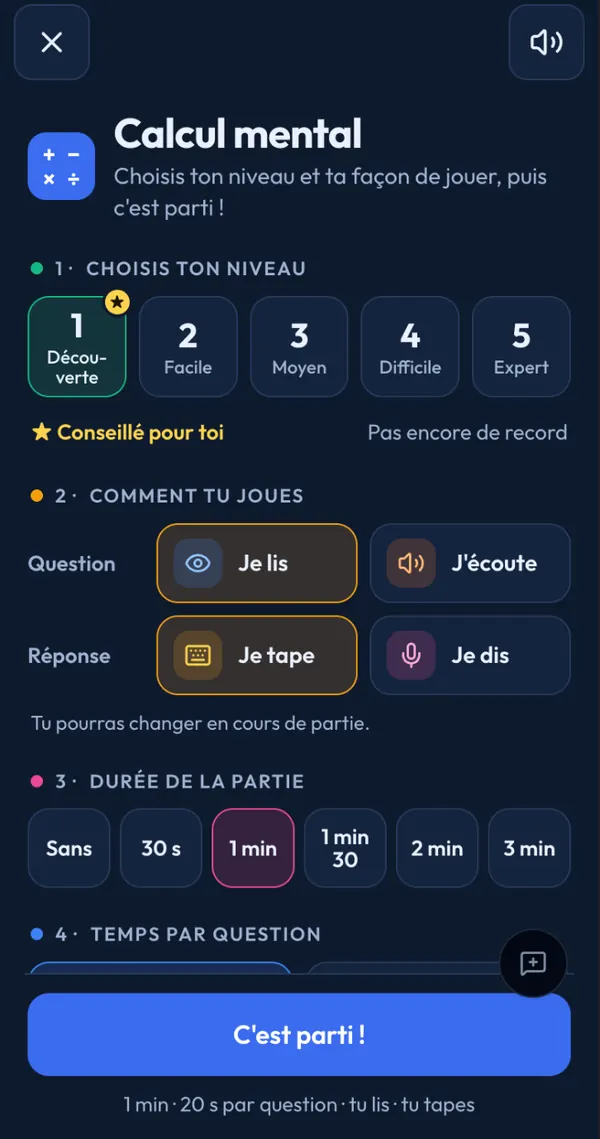
Yes. In Galac6, the question can be read out by a voice and the answer said into the microphone: your child recites their tables as they would with you, but each answer is corrected immediately.
Tables are often practised aloud, in class as at home. When speaking, the child does not waste time looking for keys: they stay focused on the calculation. They can listen to a question again, and tick “Je vérifie avant de valider” (I check before confirming) to confirm what they said before the answer counts. Series with no timer let them take their time at the start.
How can a teacher get their class to practise the tables?
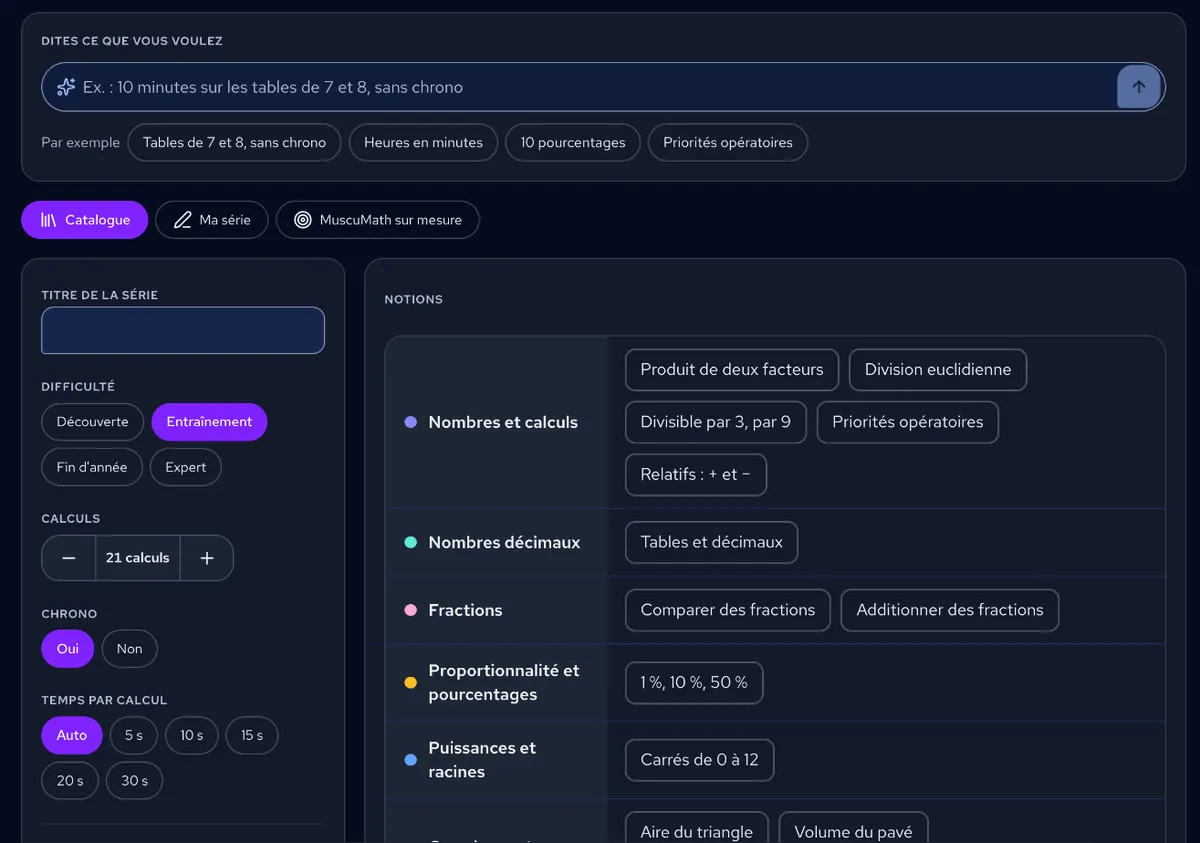
With MuscuMath, mental maths led by the teacher: you choose the tables to work on, Galac6 prepares the series, sends it to the class and marks each paper.
- The tables of your choice: under the topic “Tables de multiplication”, you tick the tables from 2 to 10 to work on, for example those of 7 and 8. If no table is ticked, all the tables are offered.
- In one sentence: you can also describe your series, for example “10 minutes on the 7 and 8 times tables, no timer”.
- The difficulty: from Découverte to Expert, fixed, progressive (harder and harder as the series goes on) or mixed.
- The tables in both directions: depending on the difficulty, the series mixes products, missing factors and “how many times?” questions.
Once the series is done, you see the class's average success rate, the most frequent mistake and, pupil by pupil, the missed calculations. With tailored MuscuMath, Galac6 then prepares for each pupil a series built on their own mistakes. For everything Galac6 offers a teacher in mathematics, read Galac6 for a maths teacher (in French).
For a school: we offer a free 3-month pilot on 3 classes. See the page Teachers and schools.
Frequently asked questions
At what age are times tables learned?
The first tables, those of 2, 5 and 10, then 3 and 4, are learned in CE1, at around 7 years old. All the tables up to 9 are memorised in CE2, then used in both directions in CM1 and CM2, for example to find how many times 7 goes into 56.
How can times tables be remembered more easily?
By starting with what is already known: 7 × 8 = 8 × 7, the 2 times table is the doubles, the 5 times table is half of the 10 times table, and 9 times a number is 10 times that number minus once. That leaves 15 results to really memorise, to be reviewed for a few minutes every day.
Can times tables be revised online with Galac6?
Yes. Galac6's mental maths series practise the tables in CE1, CE2 and CM1, and bring them back as revision in CM2. Each missed calculation is explained with a method tip and comes back in the following series until it has been got right twice.
Can my child recite their tables aloud?
Yes. Galac6 can read the question aloud and your child answers into the microphone. The answer is corrected immediately. They can listen to the question again and confirm what they said before validating.
Can a teacher work on certain tables only?
Yes, with MuscuMath. The teacher ticks the tables from 2 to 10 to work on, for example those of 7 and 8, sets the difficulty and the timer, then sends the series to their class. Galac6 marks each paper and shows each pupil's missed calculations.
How can I try it?
With the Discovery plan at €0, limited, with no bank card. The other plans are presented on the pricing page. For a school, a free 3-month pilot on 3 classes is offered.
Their tables, a few minutes a day
Create an account and let your child try a first mental maths series, at their level, in writing or aloud.
Create an account →Discovery plan at €0, limited, then €69 a year · See pricing